The Rest of the Story: November Edition
A Base64 bug that sat five months in a public issue, ninety Spring advisories in one day, and agents moving straight into the IDE.


TL;DR: we have three big threads this month, starting with the freshest one.
First up is Java4Shell, a heap overflow inside the JVM's Base64 decoder (yes, the standard library one you thought was boring and could not have new bugs anymore). An AI agent found it in October, but a user had already reported the crash in June, when it looked like a garbage collector bug.
So, humans win this one, right?
Second, we pick up October's theme: the IDE is turning into the workplace for agents. IntelliJ IDEA 2026.3 shipped Air, JetBrains tested how agents handle code they have never seen before, and the MCP Java SDK changed the protocol underneath it all.
Then an OpenJDK block ahead of the JDK 28 fork, scheduled for December 3. After the Release Radar comes a GitHub section that ends with the wave of Java4Shell repositories. Let's get into it.
1. November: The Rest of the Story

Sixty-four letters A and one equals sign.
That is the entire trigger (and I still pause at how short it looks). Pass "A".repeat(64) + "=" to java.util.Base64.getDecoder().decode(), and Java throws IllegalArgumentException because the string is invalid Base64.
On some machines, though, the decoder writes past the end of a byte array before throwing. Tracked as CVE-2026-114938, the security company Calif gave it a name you have probably heard by now: Java4Shell.
The name is a sequel. Calif explains it like this: "After we disclosed PHP2Shell, we realized many people didn't know what PHP was. So we decided to go after something a little more familiar: Java."
First, a word on intrinsics. HotSpot's JIT compiler knows a list of JDK methods that HotSpot engineers rewrote by hand in assembly for specific processors. When your code calls one of them, the JIT does not compile its Java code; it inserts the ready-made, hand-written machine code instead. That is faster, but every processor family gets its own implementation, and inside it Java guards nothing: there is no array bounds check, only what the author wrote in assembly.
The Base64 decoder has one for x86-64 CPUs with AVX-512 VBMI instructions, processing 64 bytes per step. After the main loop, a separate path handles the last 1 to 63 bytes.
When a padded tail is shorter than four characters, that path computes a negative output size. The store mask turns into all ones, and the CPU writes a full 64-byte block into a 50-byte array. Java throws the exception afterward, with the heap already corrupted.
Because every processor family has its own intrinsic, ARM64 is safe this time: the bug is in the x86 variant, so on ARM that code never runs. I talked about Java on ARM at Devoxx UK in 2025 ("Running Java on ARM - is it worth it?"). Usually, when you move to ARM, the question is what might not work the same as on x86. This time it went the other way, and owners of Graviton machines and Apple Silicon Macs can sleep well.
Before you restart every server, check JFrog's three conditions. All of them must hold. The first two are an unpatched JDK from line 17 (17.0.6 onward), 21, 25 or 27, and an x86-64 CPU with AVX-512 VBMI (Intel Xeon from Ice Lake on, or AMD from Zen 4 on; ARM64 is unaffected).
Third, outside Base64 must reach that decoder through Basic auth headers, JWTs, file uploads or network messages, which JFrog notes "usually happens before any authentication check" (right at the front door).
The fixed releases are 17.0.21.1, 21.0.13.1, 25.0.5.1 and 27.0.1.1. If you cannot upgrade today, start the JVM with -XX:-UseBASE64Intrinsics so Base64 drops back to plain Java (slower, sure, and correct).
Calif's write-up also gives a one-line check for the CPU flags and a second workaround, -XX:UseAVX=2, with a warning worth reading twice before pasting into production: "Apply this flag only on x86-64 hosts. OpenJDK on ARM doesn't recognize it and will fail to start."

So how bad is it? Calif built working exploits giving remote code execution without login in Keycloak, Jira, Confluence, Artifactory, Jenkins and PingFederate, and after login in a Kafka broker, Solr and Elasticsearch, plus a memory read "in the style of Heartbleed".
Calif also notes that "there is no universal exploit", because each target needs its own path from an HTTP request to the decoder and its own heap layout, and Calif has not published the chains. On r/netsec that was the main complaint about the branding: the top comment calls "Write once, RCE everywhere" "about as misleading as it gets", and quotes Calif's own sentence about there being no universal payload back at them.
The AI angle is the shortest part. Calif writes that Quang Luong asked Codex on October 24 to audit Netty and the JVM, "with a focus on x64 intrinsics", and "Codex found the bug within an hour". Two more hours produced the first exploit, and "the total token cost was less than $200" (expect that line in security budget meetings).
The part from before October
This part is far more interesting than the discovery itself, and Calif tells it in its own timeline: "The first public report of this bug came in June, more than four months before we independently discovered it with Codex."
On June 9, issue #1480 appeared in adoptium-support from sundarms (Sundara Mohan M): a Parallel GC crash in production, on Temurin 21.0.11. That is what heap corruption looks like from the outside: the decoder overwrites other objects, and the crash only shows up when the GC walks over them. The first advice was the classic one, switch the GC. Then came three months of persistence, a reproducer in September, and on the same day a diagnosis and a four-line patch from Albert Mingkun Yang (albertnetymk) in PR #32781.
From there the issue went through the OpenJDK vulnerability process, under an embargo you cannot see from outside, which is exactly how it is supposed to work. What shipped was commit 5177a70b by Tobias Hartmann, with Albert Mingkun Yang as co-author, under the neutral title "8393212: Base64 optimization improvements", as is usual under embargo.
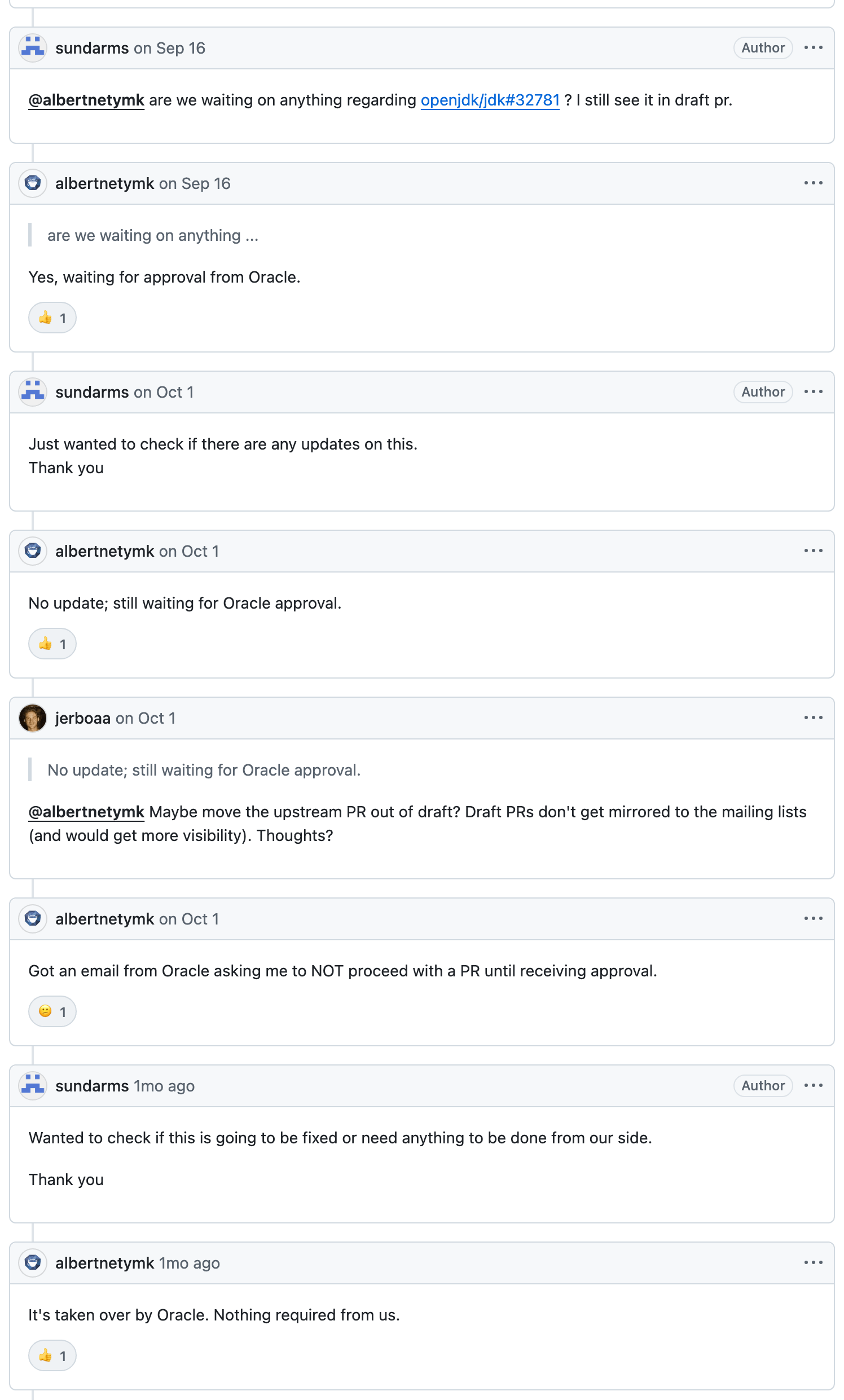
Calif writes that the bug "was patched only after we showed it could be exploited". The commit's author date, October 13, falls eleven days before Calif's discovery, but git history alone cannot settle that, because the author's machine sets that date.
For me the heroes of this story are sundarms and albertnetymk. One did not let go of a production crash for three months, the other pointed at the real culprit instead of the GC and wrote the fix right away. If anyone has ever waved you away with "try another garbage collector", this one is for you.
Where the sources disagree
Big CVEs land with conflicting details, so here are the main spots where sources diverge.
Start with severity. Oracle and OpenJDK put CVSS 3.1 at 8.1 with high attack complexity, Red Hat puts it at 9.8 and marks it critical, and Calif scores it 9.2 in CVSS 4.0 (pick whichever number convinces your team to patch sooner).
Versions can trip you up if you stop at the headline. The OpenJDK advisory covers lines 17, 21, 25 and 27, and Adoptium states JDK 8 and 11 are unaffected.
Yet Oracle also lists Java 8 Enterprise Performance Pack (8u511b33-perf), and Azul says Platform Prime is affected on Java 8 and 11 as well. Both are vendor distributions with their own backports, so check your vendor's advisory instead of stopping at the OpenJDK line number. The confusion showed up on Reddit right away. In the main r/java thread the most upvoted comment was "Thank god we're still on Java 8 /s", and one reply answered, in earnest, "Java 8 is affected too." That is true only for Oracle's Performance Pack, not for OpenJDK 8.
On timing, Calif and Red Hat list the coordinated release as 1 p.m. Pacific on November 17, while the OpenJDK advisory shows "Last update: 2026/11/17 17:44 UTC", which is earlier.
Azul notes CVE details "became public before the coordinated release", prompting customers to ask whether this was a zero-day. Azul's answer is no, adding that "no exploit was made public before the fix".
Even the model name differs across reports. Calif names Codex, whereas Engadget cites "OpenAI's GPT-6 Cyber model". Both can be true since Codex is the agent running on a model, though only Calif's wording comes from Calif.
On active exploitation, as of today, November 24, CVE-2026-114938 is not in CISA's Known Exploited Vulnerabilities catalog, though CISA issued an alert on November 17 urging immediate patching.
The JVM you forgot you run
Here is the practical headache for this week. Java4Shell is in the runtime itself, so a safe product can still run on an unpatched JVM.
Look at what JetBrains says about TeamCity: TeamCity itself is unaffected, yet its server and build agents might run on an affected JVM, while YouTrack Server received updates with a fixed bundled runtime. Build agents are the textbook JVM nobody patches because nobody treats them as servers until an advisory hits.
The Quarkus post is the clearest guide I saw, with a table by deployment model. Red Hat UBI Java images received fixes on November 19, so re-pull and rebuild.
Watch out if you run Quarkus 3.27 with the generated Dockerfile.jvm: its default base image, the UBI 9 1.23 stream, "was not fixed and will not be", so move to 1.24 images. Native executables built with Mandrel do not run on HotSpot and are unaffected, as is IBM Semeru on OpenJ9.
GraalVM Native Image also has a version split. According to GraalVM, apps built with GraalVM 25.0 or earlier are unaffected, while apps on feature releases 25.1 and later need GraalVM 25.6, "scheduled for Nov 24, 2026", plus a rebuild. It shipped on schedule: GraalVM 25.6.5.1 came out today, November 24, based on OpenJDK 25.0.5.1, the build with the fix.
In WildFly, the team writes that WildFly 41 gets no further releases with one exception: the 41.0.1 container images updated with a patched Java for Java4Shell. And Elasticsearch ships its own JDK, so updating the distribution's Java package does nothing for it, as one r/sysadmin thread found out the hard way.
Vendors moved fast. Oracle, Amazon Corretto, SapMachine and Azul shipped on November 17, with Azul getting builds out "within an hour" of the coordinated release, and Temurin, Microsoft and Red Hat followed on November 18. November is the monthly Critical Security Patch Update slot (the August cadence from vol. 190), not an out-of-band emergency drop.
One last angle before we move on. The intrinsic implements a vectorized Base64 algorithm from a 2020 paper by Wojciech Muła and Daniel Lemire. Lemire read through the code and exhaled: "As you can see, it is not the fault of our fancy algorithm. Thankfully for me."
Ethan McCue drew a contrarian conclusion: Java4Shell is an argument for Java, not against it. Ordinary Java code cannot write past the end of an array, and native code has to be switched on explicitly with a flag. This bug is in one of the few places where those rules do not apply, "a handwritten assembly intrinsic". So his advice is: "So if you are worried AI is going to find security problems with your code, use Java. The problems are likely to be less severe."
I am on Ethan's side, with one caveat. Java's safety also depends on hand-written assembly inside HotSpot, and that is exactly the kind of code where an AI agent found a hole in October, in an hour.
The rest of security came in bulk, and three frameworks tripped over the same bug.
On November 19 Spring published its monthly batch: 90 advisories, 4 of them critical. One, CVE-2026-59414 in Spring Boot, is "Possible authorization bypass due to mismatched path normalization". The same kind of bug was fixed in the same days by Quarkus (CVE-2026-87743) and Micronaut, which published 37 advisories in two days. Here is how it works. A security rule checks the path /admin/x, the router normalizes it differently (say /admin/./x), so the request passes the check as one path and runs as another. My guess: someone, or something, ran the same test against all three frameworks at once. Add Gradle with seven advisories and Keycloak with a critical CVE-2026-18963, an account takeover through password reset.
So who finds these bugs? Java4Shell came from an agent, and OpenJDK is split on it: it accepts bugs found by agents, but its Interim AI Policy bans text "generated, in part or in full, by large language models" in reports. David Holmes reminded people of that twice on the mailing lists in November, both times under a report that had found a real bug. Marit van Dijk asked the same question on Bluesky from the reader's side, and r/java talked it through in the most commented thread of the month.
And one footnote to October: 28 of the 38 Apache Camel CVEs I cited from InfoQ in vol. 197 were found by Claude, and now the project itself confirms it.
The IDE is turning into a workplace for agents, and the review stays on your desk.
Remember vol. 197, when JetBrains moved IntelliJ's Java engine into VS Code and promised a separate agent license? In November they moved agents straight into the IDE.
IntelliJ IDEA 2026.3 landed on November 5, leading with "JetBrains Air - a new layer for agentic development", and on November 11 Dominique Rolink announced Air as generally available across 2026.3 IDEs. Air runs parallel agent sessions, each isolated in its own local Git worktree, supporting Junie, Codex, Claude Agent, GitHub Copilot and others over the Agent Client Protocol (ACP).
Those agents reach the IDE through its MCP server for inspections, run configurations, database queries, refactorings and, in IntelliJ IDEA, the debugger. You review their work with "Code Notes", inline comments routed back to the agent session.
On licensing, "A paid JetBrains AI subscription is not required", and "AI Assistant is still available and supported as a separate plugin until early 2027". If you are losing track, you are not alone. There is AI Assistant with an expiry date, Junie (now also in a free Lite version), Air, where the agent can also be Copilot, and the extension that brings the IntelliJ engine to VS Code. Someone on r/Jetbrains summed it up: "It's a new one with every release though. Junie, air, you name it." And the loudest post of the month was about something else anyway: the 2026.3 splash screen that looks generated ("slopbrains", 664 points).
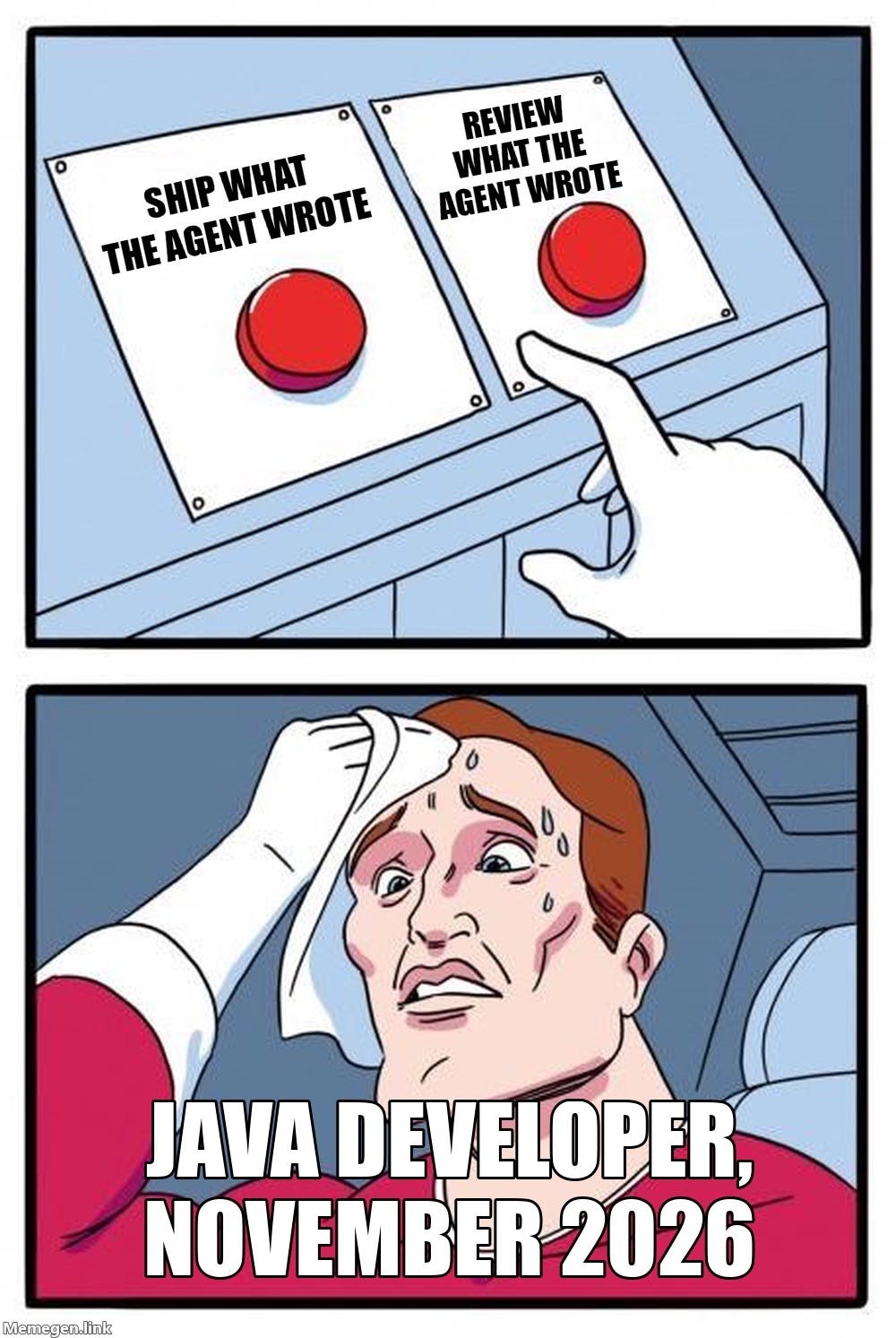
JetBrains justifies the whole turn toward agents in one sentence: "As agents write more code, individual productivity goes up, but the bottleneck moves to review." That is the direction the whole tooling industry is taking: Google wrote almost the same about Android Studio on October 28, and the IDE is turning into a station for reviewing code written by agents.
The funniest detail of the month is in JetBrains' Kotlin Benchmark 2.0 (November 23, Alyona Chernyaeva). The open-source tasks had to be cut off from the network, because instead of fixing the bug, agents went looking for the published fix online ("we found agents were doing exactly that"). Offline, the best agent solves 86.2% of the tasks from public code and 60% of those from private JetBrains projects. The sets are not identical, but the code you work on is more like the second one.
That we use agents is no longer news. State of Developer Ecosystem 2026 (28,945 responses) says "more than half of employed developers use AI agents in over 60% of their work tasks". The split by experience is more thought-provoking: 60% of people with one or two years of experience rate AI solutions above their own, against 47% of those who have been coding for 16 years or more.
The tools are being rebuilt around agents too. Kotlin Toolchain 0.14, the former Amper, now generates "MCP server configuration and an AGENTS.md file" straight from its project wizard, and kotlin publish testflight sends an iOS build to TestFlight from the terminal (not a sentence I expected to write in a JVM newsletter). Even the protocol changed: MCP Java SDK 2.2.0 brings a stateless server, with no sessions and no handshake at startup, with the caveat that "The modern API may still change in minor releases until 3.0". Spring AI 2.1.0 picked it up four days later, and LangChain4j 1.24.0 added a "Decision Scheduler", in which a small model returns a probability instead of text and routes the tasks based on it.
What does an agent workflow cost? Mario Fusco built a pull request reviewer on Quarkus LangChain4j with a router, parallel reviewers and a debate between a prosecutor, a defender and a judge (a whole courtroom for your PR). On a roughly 2,900-line LangChain4j PR, "The whole review took 5 minutes and 49 seconds and cost $0.45."
On the same note, a reader sent me a JVM-specific take on MCP. Ravi Soni built JFR Performance Lab, an MCP server that lets an assistant read Java Flight Recorder recordings. Its design principle is the most sensible sentence I read about agents and performance this month: "DO NOT ask the LLM to guess JVM problems. Give the LLM structured JVM evidence through MCP tools." The server reads .jfr files with the JDK's own jdk.jfr.consumer.RecordingFile, turns them into findings with evidence, and talks to the client through the official MCP Java SDK over STDIO. There is also a CLI mode, so you can analyze a recording without any agent at all (which is how I would start). It is a young project, with zero stars as I write this, so treat it as an interesting direction rather than a finished tool. And before you plug any MCP server into your IDE, watch Marit van Dijk's latest IntelliJ IDEA Tech Talks episode, in which Brian Vermeer explains how agents get hacked through MCP and agent skills.

And what happens when the agent has to wait for a human? Spring AI 2.1 lets you mark a tool with requiresConfirmation = true, and on November 24 Christian Tzolov explained the hard part: "Asking "may I?" is the easy part. The hard part is the wait." The approver answers minutes or hours later, maybe on another instance, maybe after a restart. Spring AI's answer is that the loop does not keep any state while it waits: "The pause is an ordinary response, and the resumption is an ordinary request." The new community project Spring AI Session Extensions stores that pause in the session log in your database. In the demo, the first JVM parks the turn and exits, a second JVM finds it and runs the approved tool once.
If that sounds familiar, it is because Temporal has been solving exactly this problem for years. It is a durable execution platform: you write a business process as ordinary code, and Temporal records every step of it. When a server dies, the process continues where it stopped, and waiting for a person is just a pause, even a very long one ("A Workflow can sleep for months", as the docs put it).
And it has what Spring AI does not have yet. Tzolov admits that in Session Extensions 0.11.0 "A parked turn has no timeout" and "There is no lease. A turn whose process died stays running until someone calls interrupt.", while Temporal has deadlines and detection of dead processes built in. You pay for that with a separate service to run and some discipline in how you write the code. Spring AI keeps everything in your app and your database, but leaves the timeout and safe retries to you ("Make the resumption safe to repeat").
So which one? For one agent and one approval step, I would start with Spring AI: it is a response, a row in a table and an advisor. For a long process with several steps, retries and deadlines, Temporal already has the answers that Spring AI is still collecting. And Spring AI knows it: the 2.1 announcement says the planned Spring AI Agent project, incubating in early December, will cover "runs that resume after a crash or wait for a person". I will be curious how much of Temporal it ends up reinventing.
OpenJDK before the fork.
JDK 28 enters Rampdown Phase One on December 3, and the schedule is final: GA on March 9, 2027, two weeks before JavaOne 2027. On the JEP side in November, JEP 547 (Lazy Constants) was targeted to JDK 28 as a fourth preview with no changes at all, JEP 535 made generational mode the default in Shenandoah, and JEP 548 is the thirteenth (yes, thirteenth) incubator of the Vector API.
The most important news is about Valhalla. David Simms told Devoxx Belgium how value classes reached mainline: almost 3,000 commits from about 64 authors. And Brian Goetz cooled any hopes for a quick finish right away (on r/java): "We are in the first preview now. Most features go through a minimum of two rounds of preview." If you want to see what it does in practice, Per-Ake Minborg packed a stock ticker into one int and made scanning an array about one and a half times faster.
In Loom, one bug is worth knowing about: with some poller modes, new virtual threads can wait a long time to start while others are busy with I/O (Morten Haraldsen saw delays of 5 to 20 seconds in a gateway on Helidon 27, and Alan Bateman confirmed the diagnosis). Mateusz Nalepa proposed a separate scheduler mode for work that mixes I/O and CPU, and got a clear, well-argued "no" from the Loom team.
And two October threads from vol. 197 moved on: the fix for excessive stat() calls during AOT training is now in mainline (PR #33622), and the proposal for reading Strings into vectors in PR #32373 got noticeably smaller after review. On jdk-dev, two votes for new JDK Committers are also under way: Vladimir Kozlov nominated Dan Heidinga for his work on Valhalla and Leyden (until December 4), and Intel's Sandhya Viswanathan nominated Mohamed Issa for JVM optimizations on Intel platforms (until December 3).
GraalVM finally explained how Crema works. Back in vol. 197 I mentioned Crema, the Java bytecode interpreter in Native Image, before its internals were written up. On November 2 Yudi Zheng published "Chasing the Perfect Assembly", following August's "Escaping the Giant Switch".
Crema is written in Java: each bytecode, like iconst_0, gets its own handler compiled separately by Graal rather than one giant switch loop.
When generated machine code trails hand-written assembly, the post asks who should budge (the compiler via a general optimization, or the interpreter supplying a fact only it knows). Yudi sums up the stance: "programmers should write straightforward Java, and our extremely smart compiler should handle the rest".
After a month showing what hand-written assembly costs when one unchecked corner case breaks bounds, chasing that speed from plain Java feels well timed. Crema is already shipping: GraalVM 25.5 (November 3, Alina Yurenko) lets Pyronaut apps run on "a reusable Crema native base", giving fast startup without rebuilding a native binary after every edit.
Now, onto this month's Release Radar.
2. Release Radar

Spring Boot 4.2 and the November Spring train
Spring Boot 4.2.0 (Moritz Halbritter, November 19) anchors this month's Spring train. New features include AMQP 1.0 support (including RabbitMQ's AMQP 1.0), opt-in OpenTelemetry semantic conventions, SSL bundles for LDAP, and a registry-backed build cache for Cloud Native Buildpacks.
Check deprecations before upgrading. RestTemplate and TestRestTemplate are deprecated for RestClient and RestTestClient, Apache Pulsar support is deprecated as Spring for Apache Pulsar moves to the Apache Software Foundation, and spring-boot-amqp becomes spring-boot-rabbitmq. WebFlux enforces default multipart limits (1 MB on disk per part, 50 parts), and everything deprecated in 4.0 is gone.
The same train shipped Spring Framework 7.1.0 (Jakarta Persistence 4.0, Hibernate 8 support and HTTP QUERY), Spring Data 2026.1.0 (Mark Paluch, Redis JSON support), a modest Spring Security 7.2.0, and Spring Cloud 2026.0.0 "Paddington" (Spencer Gibb), folding Spring Cloud Bus into Spring Cloud Stream.
Spring AI 2.1.0
Spring AI 2.1.0 (Christian Tzolov, November 20) supports the new, stateless version of MCP and adds a DecisionModel API, in which the model returns a probability instead of text: yes or no, a choice from a list, a score. The Session API replaces ChatMemory, which goes away in 3.0, and tool calls can wait for a human to approve them (I covered how that works above).
Mind the security side, too. The fixes for the CVEs from the November 19 batch are in 2.1.0 and 2.0.3, but not in the 2.1.0 milestones or release candidates, so if you were testing an RC, move to GA. "Spring AI Agent" starts incubating in early December.
Quarkus 4.0
On November 25 Guillaume Smet announced Quarkus 4.0. The new major version was two years in the making, "including planning and preparation", and tags 4.0.0 and 4.0.1 appeared on GitHub the same day. The release breaks compatibility, so read the migration guide before you upgrade.
The minimum version is Java 21, and Java 25 is recommended. Underneath, Quarkus moves to Vert.x 5 and Netty 4.2, which the announcement calls a "coordinated migration of the ecosystem that took nearly a year". With plain REST endpoints you will not notice it. You will feel it in gRPC (now on the Vert.x stack, without grpc-java), in the reactive SQL clients and in code that calls Vert.x directly. Jackson 3.1 touches almost everyone: "almost everything changed except for the annotations".
Data sits on Hibernate ORM 8.0, Reactive 5.1 and Search 9.0, which in Quarkus 4.0 are still candidate releases ("are not final yet"). Below I joke that everyone is ready for Hibernate 8 except Hibernate 8 itself. The new piece is Quarkus Data, which combines the simplicity of Panache with Jakarta Data repositories. One property, quarkus.rest.blocking.signatures.execution.mode=virtual-thread, now puts all blocking endpoints on virtual threads, and one extension turns on HTTP/3.
The new OpenTelemetry defaults need the most attention, because they change behavior without any compilation error. The OTLP protocol is now http/protobuf, the port changes from 4317 to 4318, and trace sampling drops from 100% to 10%. If one tenth of your traces is left in Jaeger after the upgrade, that is by design. For AI coding agents the recommended tool is Quarkus Agent MCP, an MCP server that runs quarkus dev itself, so it keeps working when your application fails to start.
There is no rush. Quarkus 3.40 LTS gets fixes until the end of September 2027, and 3.33 LTS until the end of March 2027. If you run on Camel, you will wait anyway, because Camel Quarkus is still being migrated.
Gradle 9.9
Gradle 9.9.0 landed on November 6 with faster Kotlin build scripts. Kotlin DSL scripts compile incrementally through the Kotlin Build Tools API, "65% faster" in one large performance benchmark. --tests filters non-method JUnit Platform tests such as ArchUnit rules, and Test Retry reruns only failed ones. Breaking changes mostly hit tool authors via renamed problem IDs.
Patches 9.9.1 and 9.9.2 followed by November 19 alongside 8.14.7 and 8.14.8, the first 8.x builds fixing the section 1 advisories.
sbt 2.1.0 and Scala 3.10.1
sbt 2.1.0 (Eugene Yokota, November 16) finally drops Apache Ivy from dependency resolution and publishing. Build definitions run on Scala 3.9 LTS, test runs print a summary, and the remote cache gains an HTTP endpoint alongside gRPC.
Plugins built for sbt 2.1 will not run on 2.0.x, and the release notes suggest 2.1 as the plugin baseline since Scala 3.9 is an LTS (2.1.1 followed on November 23).
Scala 3.10.1 (Wojciech Mazur, November 11) adds JDK 28 as a target and warns when code calls synchronized on Java value-based classes, "which JDK 28 rejects". Valhalla is already knocking on other JVM languages.
Apache Pekko 2.0.0
Pekko 2.0.0, the Apache fork of Akka created after its license shift, is its first major release since the split. It requires Java 17 and drops Scala 2.12, and its Java API stops leaking Scala types in favor of CompletionStage, Optional and Java collections.
More dispatcher types support virtual threads, and VarHandles replace sun.misc.Unsafe. Binary compatibility with 1.x is broken and the Artery remoting header changes, so plan rolling cluster upgrades carefully.
Hibernate ORM 8.0.0.CR1 and Hibernate Validator 9.2
Hibernate ORM 8.0.0.CR1 (Steve Ebersole, November 12) implements Jakarta Persistence 4.0 and Jakarta Data 1.1, enabling graph-based flush coordination by default (old mode: hibernate.flush.queue.type=legacy).
Final still has no date, which gave me a chuckle: Spring Framework 7.1, Spring Data 2026.1 and IntelliJ IDEA 2026.3 all announced Hibernate 8 support in November, so everyone is ready except Hibernate 8 itself.
Hibernate Validator 9.2.0.Final (Marko Bekhta, November 20) adds password constraints (@PasswordStrength, @NotCompromised, @PasswordPolicy) plus roughly 20 others such as @IBAN and @Port, escaping message parameters by default.
TornadoVM 8.1.0 and 8.2.0, jitLLM 3.0.0
TornadoVM 8.0 appeared in vol. 197, and November brought two more releases right away. 8.1.0 (November 6) removes setup pain: the drivers are now on Maven Central, so TornadoVM runs without a local SDK, and a kernel can work on GPU memory owned by another library without copying.
8.2.0, out today, November 24, adds a backend for AMD GPUs (HIP and ROCm) and also runs on OpenJ9, that is IBM Semeru. On top of that, an ordinary Java method can now be compiled into a CUDA function for cuDF, and StrictMath functions give bit-identical results on the GPU and on the JVM.
jitLLM 3.0.0 (November 12), the same team's LLM inference engine formerly known as GPULlama3.java, builds on this. On Apple silicon it reads model weights directly from unified memory, prefill is faster on Metal and CUDA, and the whole thing also compiles to a GraalVM native image.
Elide 1.6.0–1.6.3
Elide, the single-binary runtime and toolchain from vol. 199, has been shipping a whole 1.6 series since mid-October, and it points one way: Elide wants to be a build tool, not only a runtime. 1.6.0 from October 16 (briefly covered in vol. 197) brought multi-module projects, publishing artifacts to Maven, from the local repository up to Maven Central, and running OpenRewrite recipes without a build plugin.
1.6.2 (November 1) adds a built-in C compiler (elide cc) and elide jextract, which turns C headers into ready Java FFM bindings. 1.6.3 (November 11) goes further: it experimentally builds and runs an Android app without Gradle (you can hear the eyebrows rising), ships Spring Boot and Micronaut templates, elide adopt for migrating existing Spring Boot projects, Testcontainers declared in the config, and a plugin that gives Claude Code and Codex the build graph and test results.
GraalVM 25.6
First, a word on the numbering, because it can confuse. GraalVM now has two lines: Oracle GraalVM 25.0.x only gets security fixes, and since 25.1 a new feature release ships every month and supersedes the previous one. GraalVM 25.6, out today, November 24, is the latest of those, and the next one, 25.7, is planned for January 26.
It matters for Java4Shell: 25.6 is based on OpenJDK 25.0.5.1 with the fix, so if you build Native Image apps on 25.1 or later, rebuild them on 25.6. My favorite new thing is a small one: a native image can now print at startup which options it runs with and where each one came from (the build, the command line or runtime). It also accepts flags you know from HotSpot, so old startup scripts break less often. GraalPy got a nicer REPL and a faster decimal module, and people building on Truffle have two breaking changes to read about in the release notes.
CheerpJ 5.0
CheerpJ 5.0 (Alessandro Pignotti, November 2) brings Java 21 and 25 to the browser via WebAssembly alongside 8, 11 and 17. Every version bundles the full JDK, so javac runs in the browser too. It includes the experimental WasmGC engine powered by the browser's GC from vol. 199, targeting CheerpJ 6.0 production readiness "in early 2027".
Helidon 27.0.2 and 4.5.7
Wrapping up Release Radar with a patch release that changes default behavior. Starting in Helidon 27.0.2 and 4.5.7 (November 17), request and response bodies Helidon buffers fully in memory (strings, byte arrays, JSON, forms and buffered multipart parts) are capped at 1 MiB by default, while streaming reads stay unaffected.
For larger buffered payloads, set max-buffered-entity-size. Helidon 27 requires Java 27.
3. GitHub All-Stars

A funny habit ties this month's picks together: JVM tools that refuse to run on the JVM. October gave us ktrs and midden, November continues in Go and Rust (plus one project going the other way), and a bonus round covers Java4Shell.
kotlin-compiler-go, a Kotlin compiler in Go
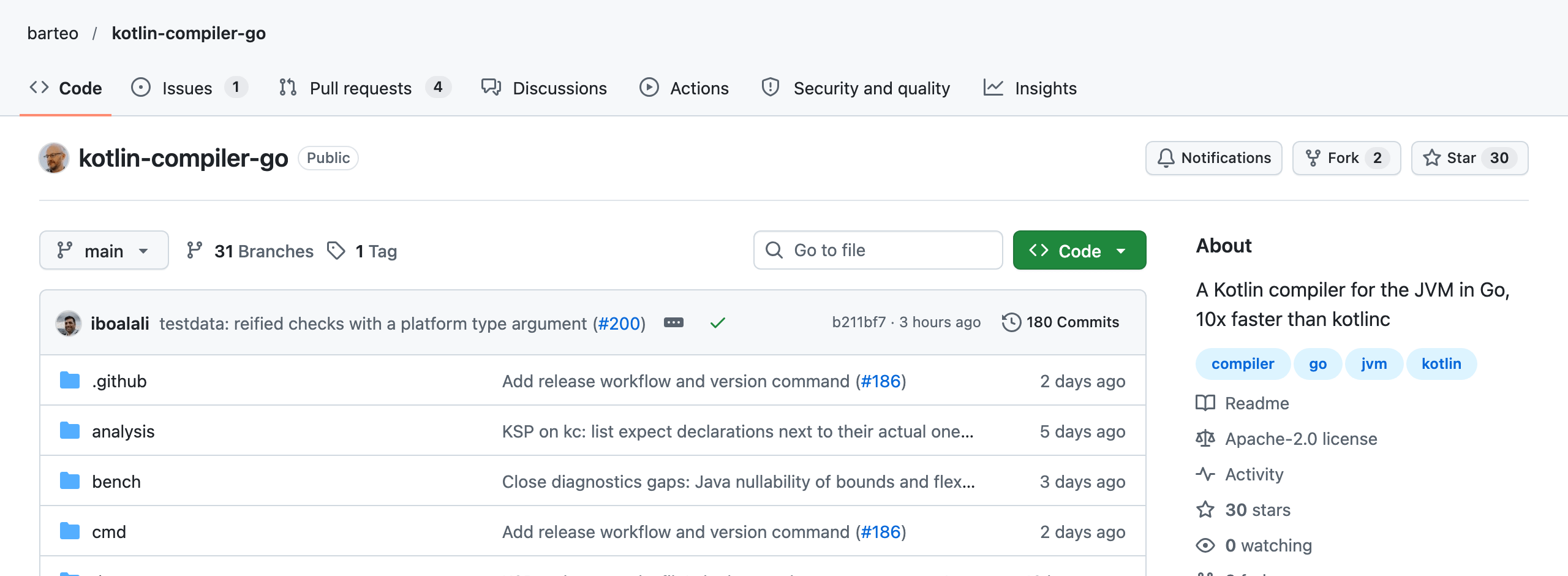
kotlin-compiler-go is kc, "a Kotlin compiler for the JVM, written in Go", by Bartek Teodorczyk. The README says it compiles over 10x faster than kotlinc in a warm JVM with about a tenth of the memory: 643 ms against 6.88 s on kotlinx-coroutines-core.
It is worth a look because the benchmark scripts are in the repo, and the author says plainly that it is a prototype that "checks less than kotlinc does". The README tells you to keep kotlinc in CI and release builds. My favorite detail: in the November 19 benchmark logs, the machine measuring a compiler built to avoid the JVM ran its JVM with the Java4Shell workaround on.
java-analyzer, a Java language server in Rust
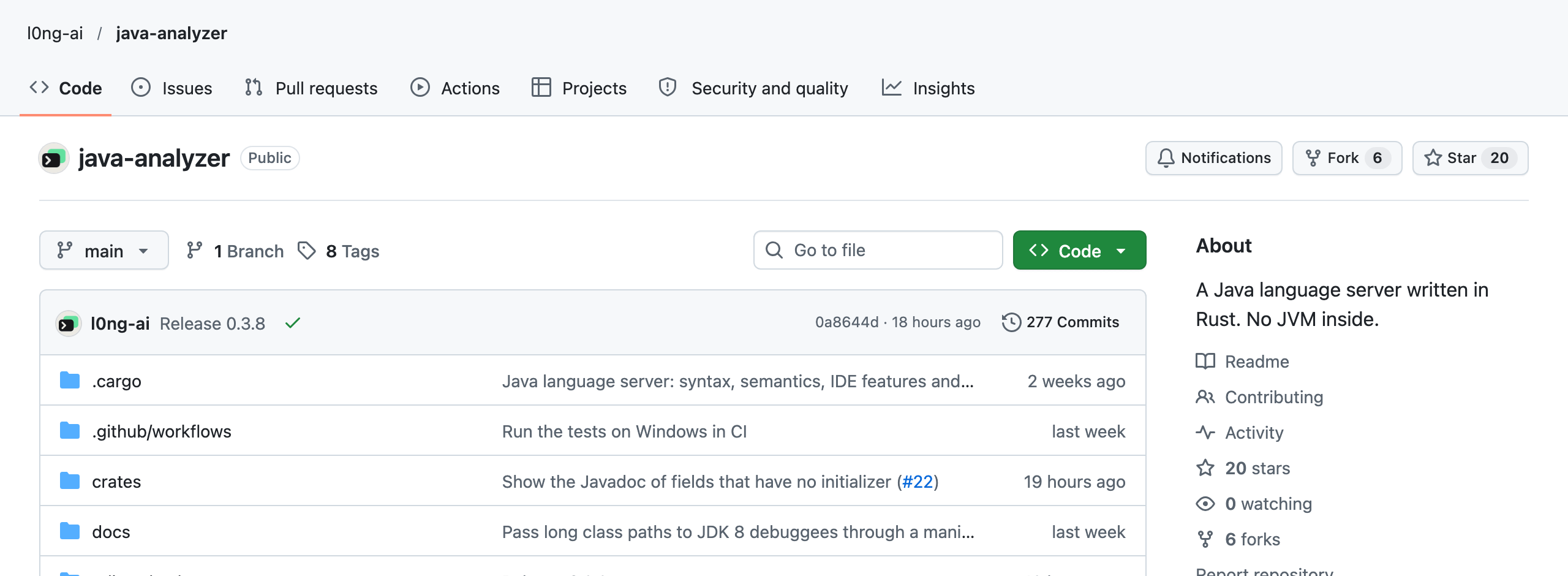
java-analyzer is "A Java language server written in Rust. No JVM inside." Parsing, name resolution, type inference and flow analysis are reimplemented as an incremental Rust program, and the same binary includes a JDWP debugger.
The interesting part is where the promise ends. Gradle scripts are executable code that "cannot be parsed statically", so for Gradle projects the server still runs ./gradlew once.
scruff, a Scala linter and formatter in Rust
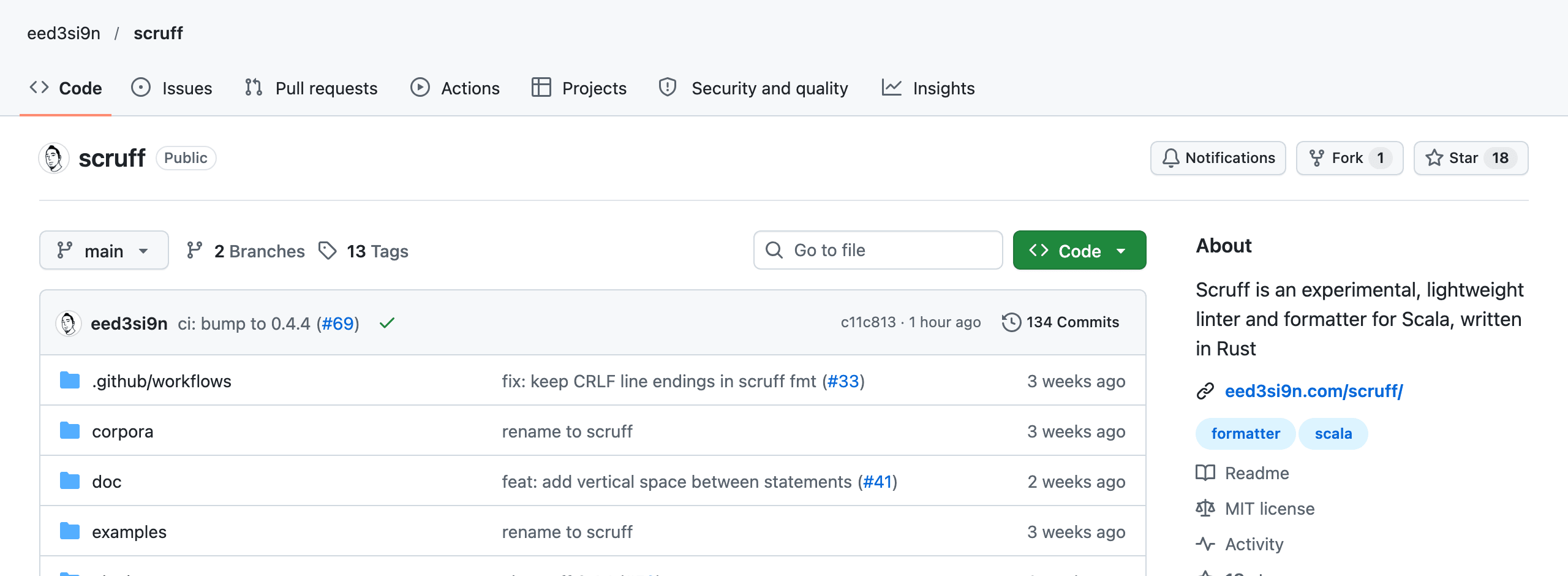
scruff comes from Eugene Yokota, who also shipped sbt 2.1.0 this month. It is an experimental Scala linter and formatter on Tree-Sitter, written in Rust and deliberately without style options: "Scruff removes all configurations related to styling."
The docs report it is "about 6x faster than Scalafmt out of the box". Rule S009 gives away its author: it flags sbt 0.13 scoping like scalacOptions in Compile, and --fix converts it to slash syntax because "sbt 2 removes it".
rust-anything, moving code out of the JVM with proof
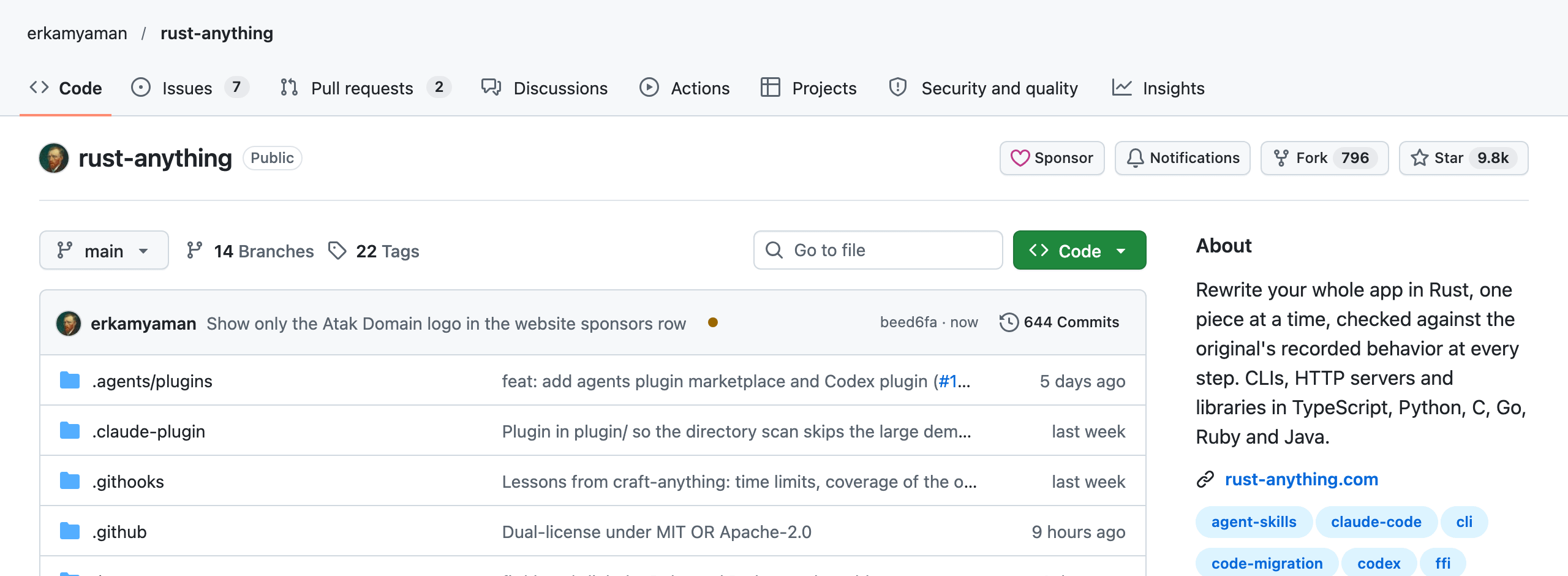
rust-anything gained 8,800 stars in one week. It records what your app does today (Java and Kotlin included) and checks every piece of the Rust rewrite against that recording: "It doesn't translate code; it proves the rewrite."
For Java, the unit of migration is a class of public static methods wired to Rust over JNI. Next to it, a <Class>Shadow class calls both versions and counts mismatches. The README states the limit itself: "It can only catch what the recording covers".
Reckoning, an LLM engine in plain Java
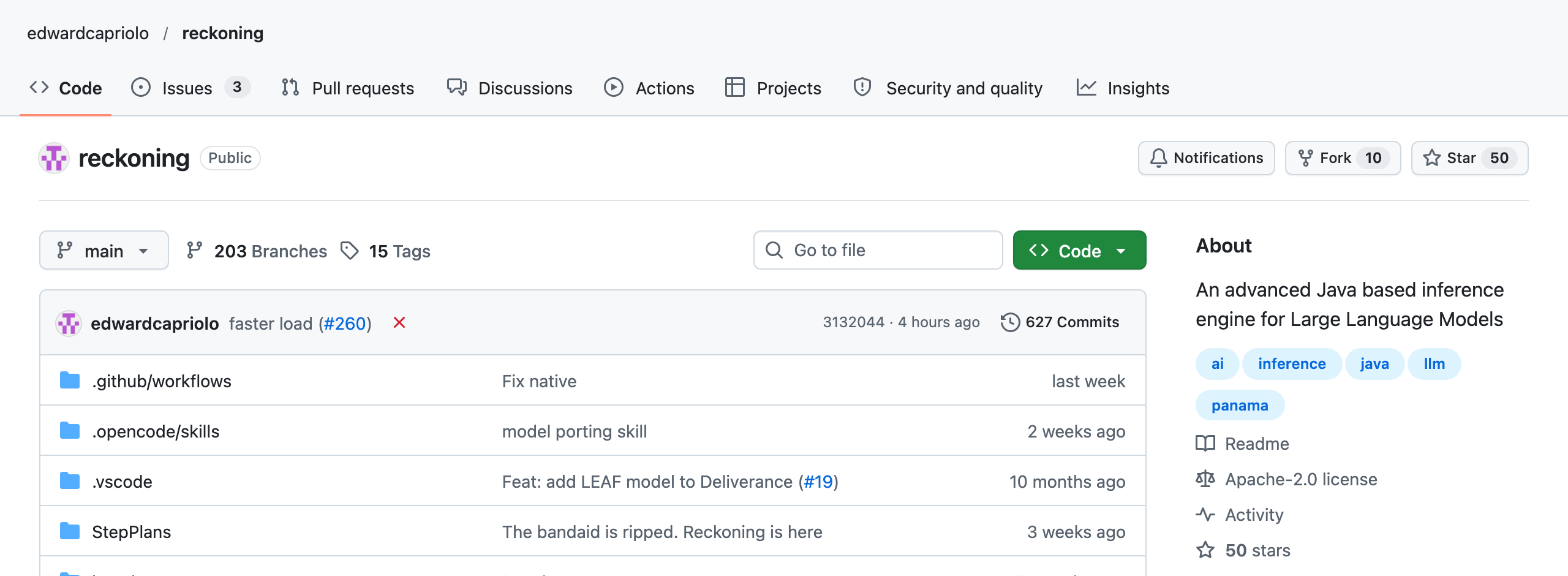
Reckoning is an LLM inference engine written in Java by Edward Capriolo (Apache 2.0 license). It runs Llama, Mistral, Qwen3 and Granite 4.0 locally and gets its speed partly from the Vector API. Version 0.0.17 from November 10 moved the engine to a new tensor layer and added an API for pulling models.
Edward sent me the project himself, together with a LinkedIn post that presents moving from Python to Java as a twelve-step program: "You will miss the GIL." I like the self-irony, and I like even more that in the month of rust-anything someone pushes code the other way.
minecraft-server-on-orange-cloud, Minecraft Java on Cloudflare
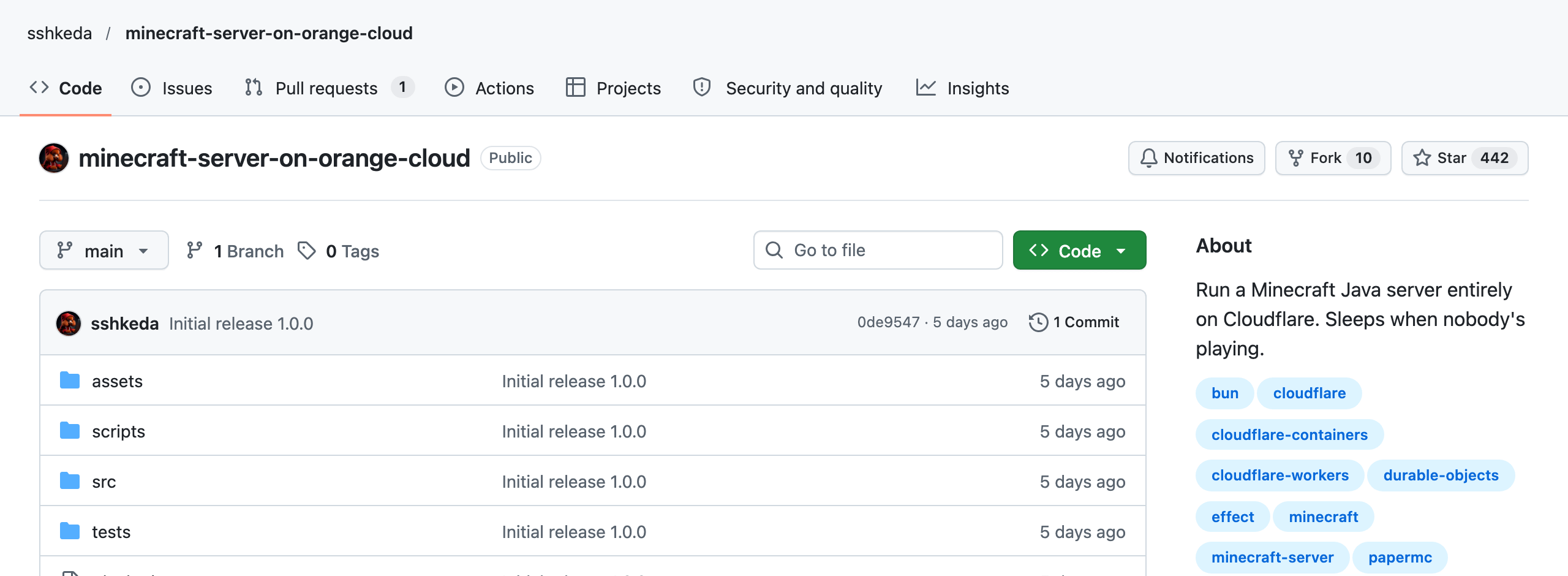
minecraft-server-on-orange-cloud runs a Paper server for Minecraft Java "entirely on Cloudflare". After 10 minutes without players it saves the world and sleeps, and while it wakes up, a TypeScript Worker answers in the Minecraft protocol, so the server list shows "Waking up. Refresh in 30 seconds." instead of an error. The Temurin image is pinned to 25.0.5.1, the build with the Java4Shell fix.
Bonus: one week of Java4Shell on GitHub
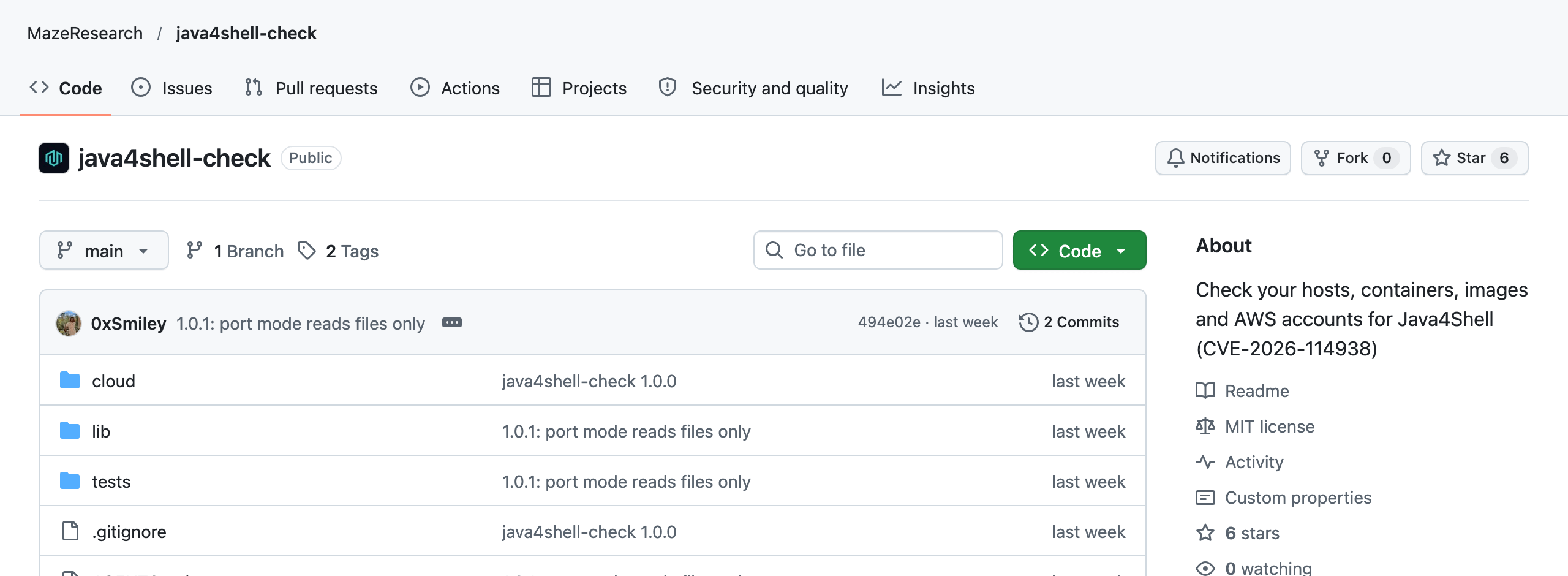
Between November 17 and 24, GitHub search returns about 112 new Java4Shell repositories, mostly scanners, labs and detection rules. Of the defensive ones, I read and recommend four. java4shell-check by Maze checks hosts locally, because "There's no safe way to check this over the network". java4shell-runtime-patch by Theori patches a live JVM without a restart by blocking C2 from compiling Base64$Decoder.decode0 (it installs via curl | sh, so read the script first). cloudrasp-java4shell by BoundaryX intercepts decode0 with a ByteBuddy agent and rejects only malformed input. Semgrep's detection scripts appeared about eleven hours before the advisory. I am not linking the wave's most popular exploit.
PS: Maven 4.0.0 GA is still missing. November brought Maven 3.10.1 and 3.10.2, backporting a few Maven 4 features including -P ?id, while Maven 4.0.0-rc-7 from September remains the latest 4.x tag, so the weeks are still coming.
PS2: Mike Milinkovich announced on November 3 that he will retire as Executive Director of the Eclipse Foundation in 2027, after 22 years, and a search committee is looking for his successor. Jakarta EE, Adoptium and Temurin all grew up under his watch, and this month Temurin shipped the Java4Shell fix within a day. Thank you, Mike.
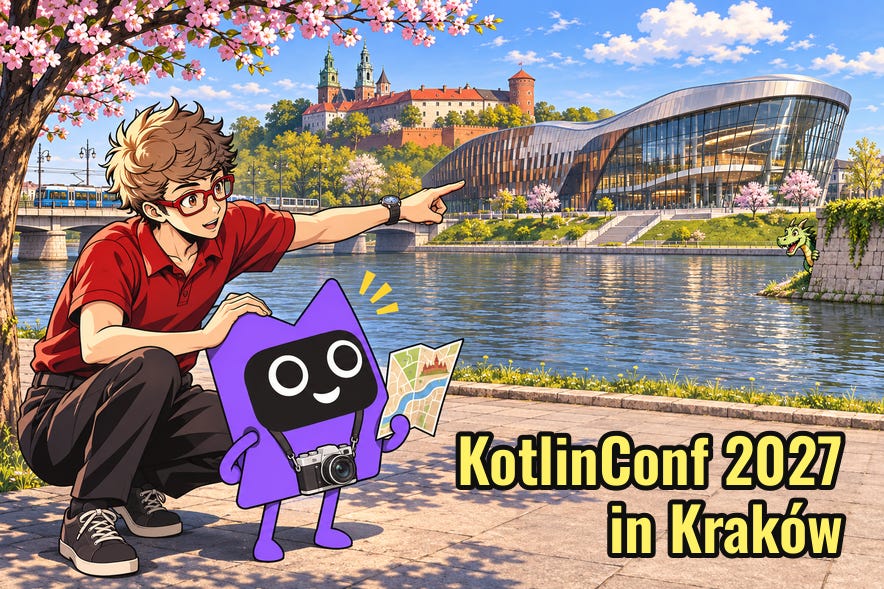
PS3: A Black Friday-season reminder from my own city. KotlinConf 2027 takes place in Kraków, at the ICE Congress Centre, on April 21 to 23, and the conference pass is now 750 PLN off: 2,350 PLN instead of 3,100 PLN (before VAT). The site says the price is valid through December 10, 2026, and prices go up step by step until the event. I will be there too, so if your team was waiting for a reason to come to Kraków, this is it. Find me and say hi, and the pierogi are on me (figuratively).
Thanks for reading JVM Weekly!
Discussion about this post