


This is one of those weeks where you have to set aside the technology and talk about the elephant in the room. When the company that stewards Java lays off 18% of its global workforce, and its CEO publicly says “the code that Oracle is writing, Oracle isn’t writing - our AI models are writing it,“ it’s hard to pretend this is “just another restructuring.”
But at the same time, paradoxically, this has also been one of the best periods for the Java AI ecosystem ever. So today we’ll try to piece these two pictures into a single coherent narrative. Fair warning: it won’t be easy, but I hope it will be educational.
On March 31, 2026, around six in the morning Pacific time, Oracle employees around the world started receiving emails. Not invitations to a meeting with their manager, not a heads-up from HR. Emails. From “Oracle Leadership.” Before breakfast.
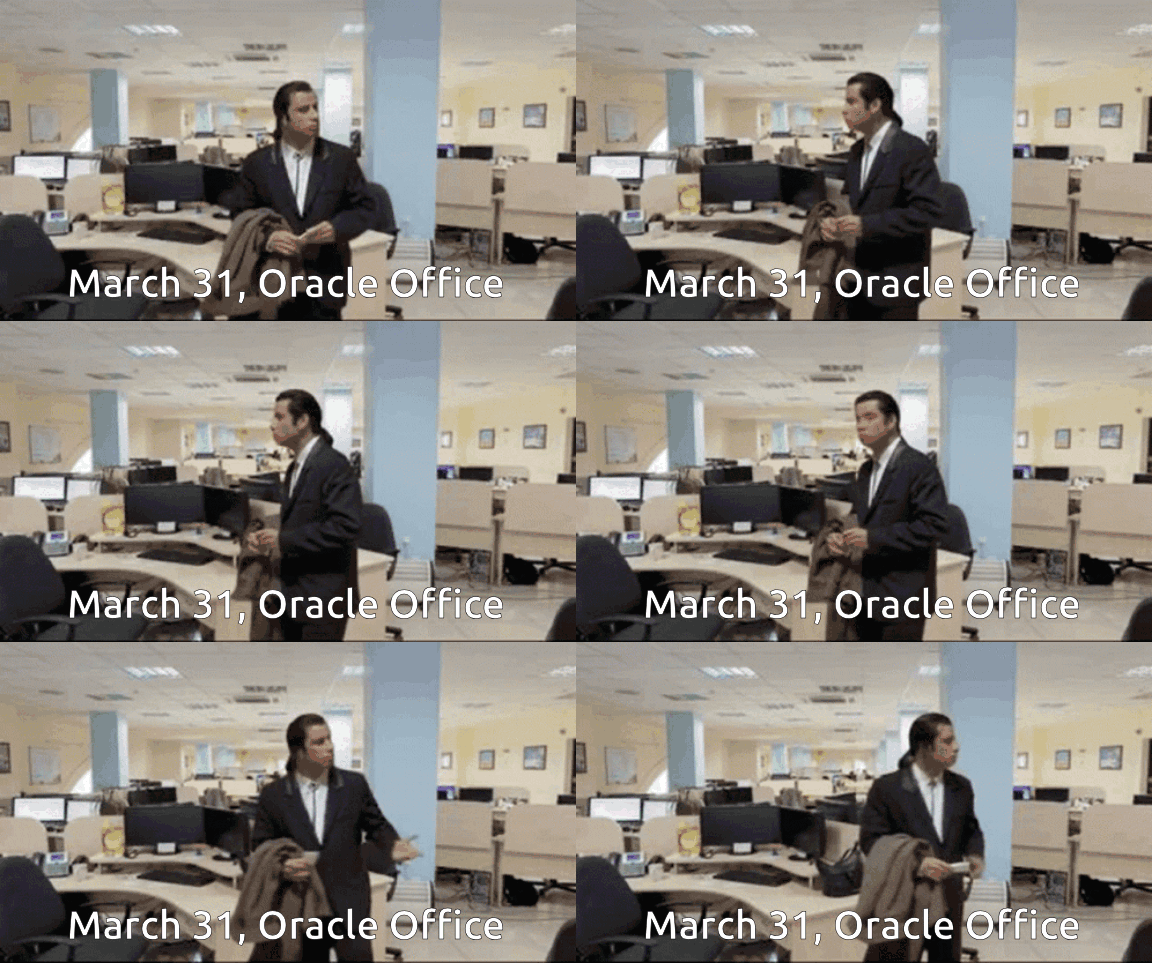
According to data that leaked over the following days, the layoffs affected up to 30,000 people, roughly 18% of Oracle’s global workforce. CNBC confirmed the scale from two independent sources. The company set aside a restructuring budget of around $2.1 billion, mostly for severance. TD Cowen estimates the layoffs will free up $8 to $10 billion in annual cash flow. Money that, as you can easily guess, will go toward building AI data centers. Oracle’s capex for fiscal year 2026 is around $50 billion, $15 billion more than the company told Wall Street just a few months ago.
But it’s not the numbers that hurt the most. It’s the people.
Among those laid off was Sharat Chander, Head of Developer Community Engagement at Oracle, a person who spent 16 years (first at Sun Microsystems, then Oracle) building what you can, without exaggeration, call the largest developer ecosystem on the planet. His farewell post on LinkedIn was one of those that’s hard to read without feeling something:
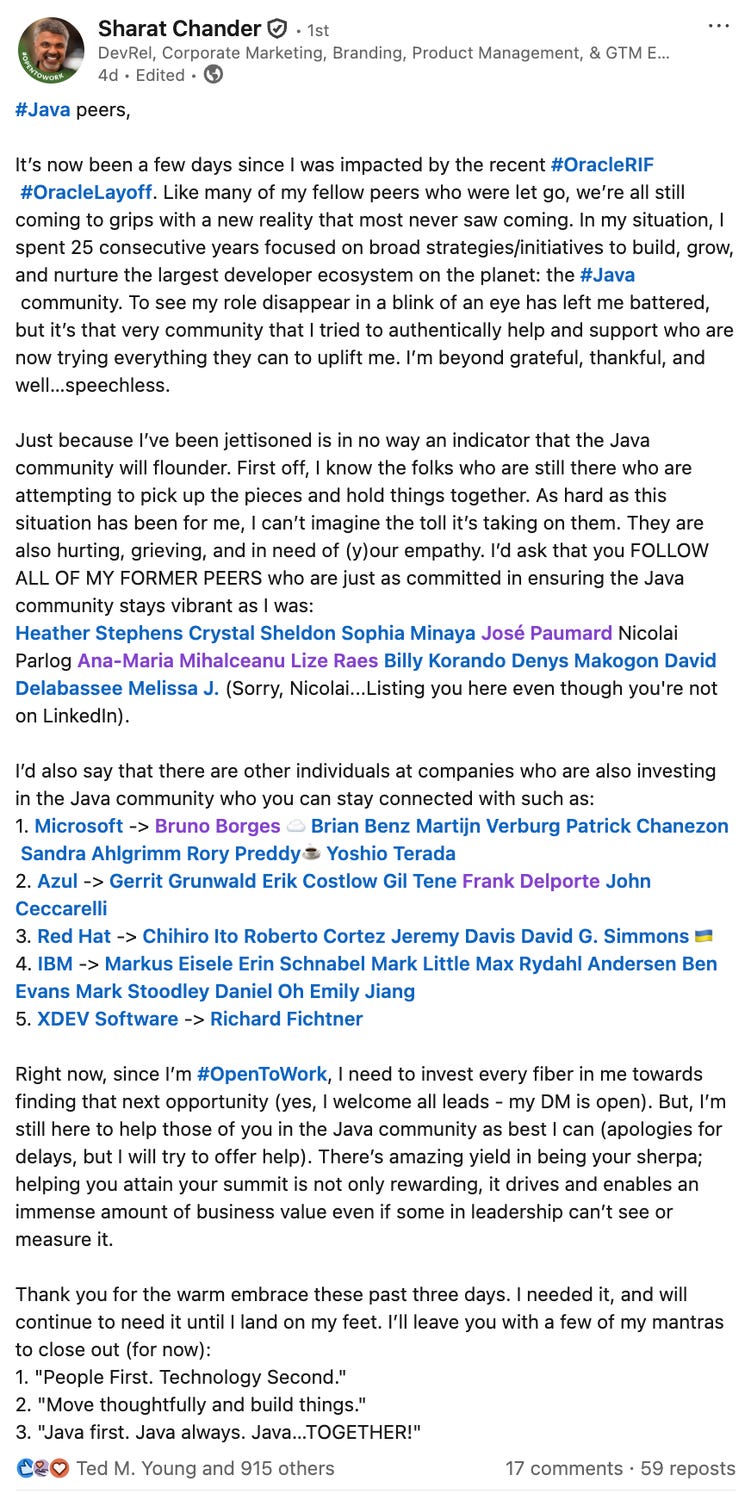
So what does this mean for Java itself? At first glance: nothing. Oracle has repeatedly made it clear that the JDK, OpenJDK, and the entire six-month release cadence machinery is a key asset. Georges Saab, Chad Arimura, and the Java DevRel team are (for now) still in place. But it’s hard to watch the layoff of Sharat, the person who WAS Oracle’s community engagement, and not feel uneasy. Especially when we remember what happened at Sun right before the Oracle acquisition: 18% workforce cuts in 2008 (yes, the same percentage - you can’t make this up), another 3,000 during the deal delay in 2009, and then James Gosling, Tim Bray, and Simon Phipps walking out the door within months of the close. The community-facing roles were among the first to go then, too.
And then there’s that Larry Ellison quote: “The code that Oracle is writing, Oracle isn’t writing. Our AI models are writing it.“ That was said publicly. And regardless of how much of this is CEO hyperbole for analysts, 30,000 people just lost their jobs, and that narrative is their backdrop.
Remember JavaOne two weeks earlier? The “Java for an AI World” keynote, Java Verified Portfolio, Project Detroit, Helidon with LangChain4j - I wrote about it in more detail in vol. 167. Back then it looked like a bold ecosystem pivot. Today, in the context of the layoffs, that same keynote reads a bit differently. “Java for an AI World,” but not necessarily for all the people who built it.
And here we arrive at the paradox of this edition. Because regardless of what Oracle the corporation does, the AI ecosystem on the JVM has never looked better. And this isn’t hype - these are concrete developments from the past two weeks. JavaOne gave us “AI World” in a keynote, but the real answer from the community is visible in the projects that appeared right after.
-Let’s start with the biggest one. On March 30, Guillaume Laforge announced the GA release of Agent Development Kit for Java version 1.0.0 from Google. A full-fledged, code-first framework for building AI agents in Java, with Human-in-the-Loop (built around a ToolConfirmation mechanism that elegantly pauses the LLM flow and waits for approval), A2A Protocol support (agent-to-agent communication), sessions via Firestore and Vertex AI, and LangChain4j integration. Plus a Dev UI identical to the Python counterpart.
This is big. Google, a company that in the AI context is associated primarily with Python, is saying outright: Java is a first-class citizen in our agent stack. Guillaume wrote an excellent blog post about building a multi-agent “Comic Trip” application using ADK, complete with Google Maps integration, Firestore persistence, and a UI generated by Antigravity. I recommend it as an example of what building agents on the JVM looks like in 2026 - without pretending it’s Python.

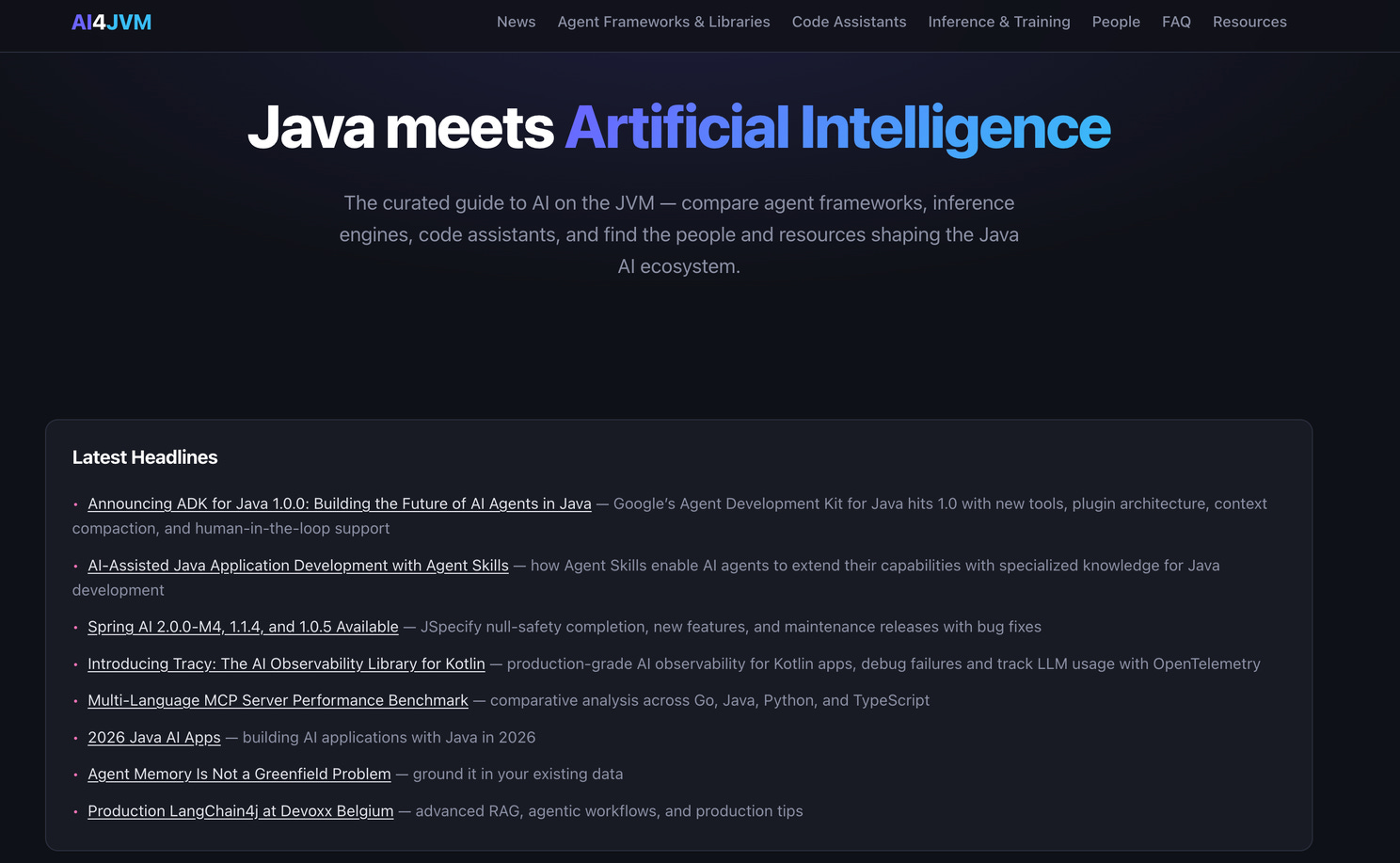
And since we’re talking about people who do more than they say (while saying a lot): James Ward rallied the community and launched ai4jvm.com. A curated catalog of literally everything AI on the JVM: agent frameworks (Spring AI, LangChain4j, Embabel, Koog, Google ADK...), inference engines, code assistants, key people, educational resources. Not another awesome-list on GitHub, but a properly built site with a clear taxonomy that gives you a real picture of how vast this ecosystem has become.
James is everywhere right now: from episode 200 of the AWS Developers Podcast (with Josh Long, where the cited Java MCP SDK vs Python benchmarks are... encouraging: 0.835ms latency vs 26.45ms), tthrough JavaOne presentations on MCP and agent skills, to his SkillsJars project for packaging and distributing reusable AI agent skills as Maven/Gradle JARs (discover via Maven Central, load on demand in Claude Code or Spring AI), and the javadocs.dev/mcp server that gives AI agents structured, up-to-date access to Java library documentation instead of relying on stale training data.

The very existence of something like ai4jvm.com is telling. Just a year ago, when I wrote Hitchhiker’s Guide to AI in the Java Galaxy, the ecosystem fit into one (albeit long) article. Today it needs its own portal (and soon probably a search engine).
But agents aside, plenty is happening at a lower level of abstraction too. On April 2, TornadoVM 4.0.0 shipped with the thing I’d been personally waiting for: a native Apple Metal backend enabling heterogeneous compute directly on Apple Silicon. For those who haven’t followed previous editions, TornadoVM is an OpenJDK plugin that transpiles bytecode at runtime to OpenCL C, NVIDIA PTX, or SPIR-V, automatically running Java programs on GPUs, FPGAs, and multi-core CPUs. Version 4.0 adds Metal to that arsenal, along with SIMD shuffle and reduction intrinsics in the PTX backend, a new withCUDAGraph() method on TornadoExecutionPlan, and support for both JDK 21 and JDK 25.
I currently started experimenting with TornadoVM 4.0 and updated my Llama benchmarks - results soon.
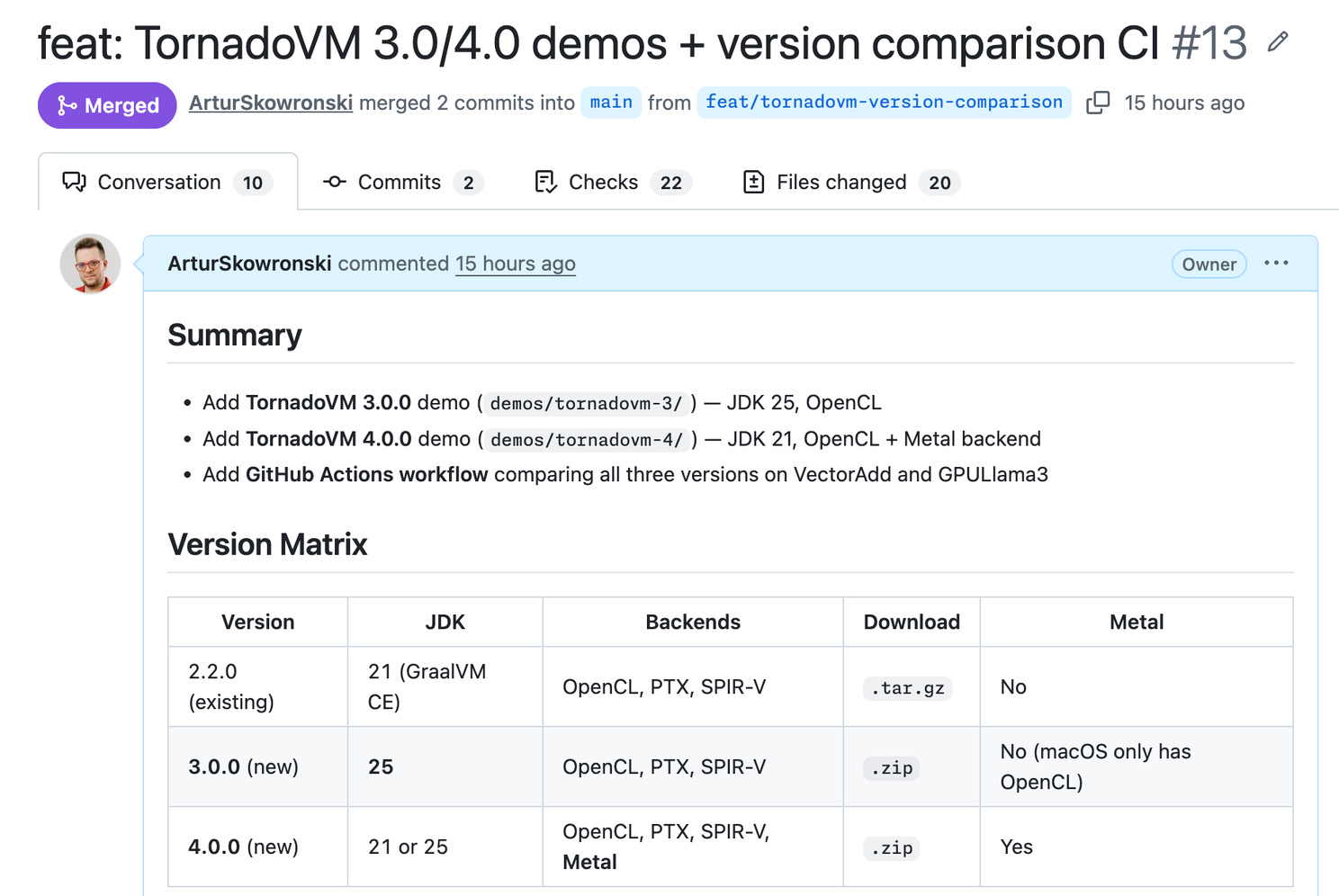
What does this mean in practice? MacBook users on M1/M2/M3/M4/M5 can finally use native GPU acceleration without OpenCL workarounds. And given how many people in the Java community work on Macs, and that GPULlama3.java is one of the most interesting projects in this space, the Metal backend opens it up to an entirely new group of developers.

On a side note, because it fits the theme of a community that’s doing its own thing: Mark Sailes and Lee Gilmore just launched StudyFromExperts, an educational platform targeting advanced AWS practitioners. Their pitch is simple: most training material is written for people just starting their cloud journey, while senior engineers and architects are left to fend for themselves. Mark is well known in the Java/serverless ecosystem, so I’ll be watching what grows from this.
See the pattern? Google builds an agent framework. AWS evangelizes the ecosystem. Manchester delivers Metal on GPU. JetBrains bets on agent orchestration. Sailes and Gilmore build an educational platform. None of them are waiting for Oracle.
PS: If you’re by any slight chance reading this, Sharat: thank you for those 16 years. The Java ecosystem wouldn’t be what it is without your work. And whatever comes next, the community remembers.
PS2: I recommend ai4jvm.com as a starting point for anyone who wants to understand just how vast the AI ecosystem on the JVM is today.